
AutoStore, AS/RS, G2P and robots, run from .wms.
Thomax implements AutoStore, AS/RS, goods-to-person and sortation on the WMS that already runs your orders. Where a site needs its own control layer we build a white-box WCS. Where a vendor's system controls itself we integrate it, with 24/7 support after go-live.
Automation delivered for cold storage, online retail and national store networks across Australia and New Zealand, with teams across APAC, the UK and Europe, and North America.
Every system type, on the WMS you already run.
Each system below is implemented on .wms today or connects through interfaces we have built. Where the vendor's software controls the machine, we integrate it. Where the site needs a control layer of its own, we build it.
| System | What it is | What it does for you |
|---|---|---|
| AutoStore (cube storage) | Robots on a grid deliver bins to ports; .wms releases the orders and takes back every pick and stock change | The densest goods-to-person storage in wide use, live on .wms at the centre of a national retail network. |
| Automated storage and retrieval systems (AS/RS), unit-load and mini-load | Crane-based pallet and tote storage from vendors such as Dematic and SSI Schaefer | High-density storage with the stock record, rotation and holds still owned by the WMS. |
| Shuttle systems, carton and tote | Multi-level shuttles feeding pick stations and sorters | Peak-day throughput without adding pickers, on the same waves as the manual floor. |
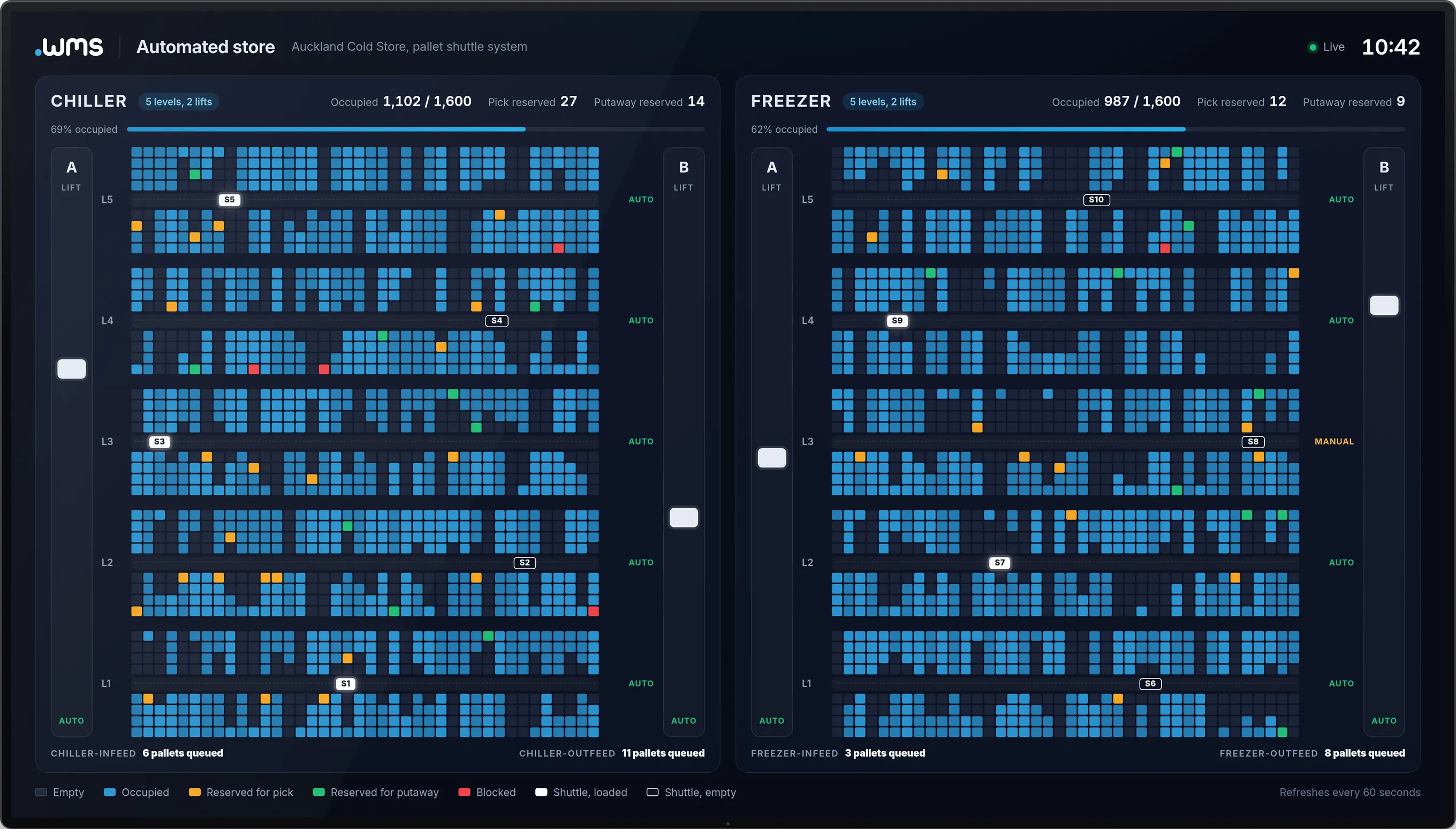
| Pallet shuttles, multi-level and deep-lane | Shuttles, lifts, conveyors and turntables directed by a Thomax-built WCS in a live chiller and freezer store | Deep-lane density with fewer people in the cold, and a redundancy mode when a lift or side is down. |
| Vertical lift modules (VLMs) and carousels | Modula and similar units for small parts and high-value lines | Secure, compact storage for the slow and the valuable, with every retrieval logged against the order. |
| System | What it is | What it does for you |
|---|---|---|
| Goods-to-person (G2P) stations | Stock and order totes arriving at pick, replenishment and pack stations we built, with pick-to-light guiding the operator | Walk-free picking with the station screens, lights and labels run by the same system as the order. |
| Autonomous mobile robots (AMRs) | Fleets from Geek+, Locus Robotics and Mushiny that take work from .wms and report every pick, receipt and stock change back | Add robots by the zone without a fixed install; the fleet runs its own motion, .wms runs the warehouse. |
| Automated guided vehicles (AGVs) | Pallet and tote moves between dock, storage and lines, released from the WMS task queue | Dock-to-storage moves without a forklift driver, confirmed back to the pallet record. |
| Autonomous case-handling robots (ACRs) | Tote-to-person from tall racking, integrated the same way as AMR fleets | Goods-to-person density inside the building you already have. |
| Robotic piece picking | Picks released to the robot cell, confirmations back on the order, exceptions to a person | Automated picking for the lines that suit it, manual for the rest, on one wave. |
| System | What it is | What it does for you |
|---|---|---|
| Pick-to-light (PTL) | Lights we drive directly at pick and pack positions | Faster, more accurate station picking with no vendor software between the light and the order. |
| Put walls and put-to-light | Scan-to-slot walls native to .wms, with lights where the site wants them | Bulk picks sorted into orders, express orders pulled forward, late orders flagged on the wall. |
| Sortation: cross-belt, tilt-tray, sliding-shoe and pocket sorters | Lane and divert decisions taken from .wms rules; the sorter runs the mechanics | Every carton to the right carrier, store or pack lane, on rules your team can change. |
| Conveyors | Point-to-point moves, merges and diverts through PLC and controller message interfaces | The floor moves the work; the WMS decides where it goes. |
| Voice | Voice-directed picking on the same waves | Hands and eyes free for bulk and case picking. |
| System | What it is | What it does for you |
|---|---|---|
| Right-size packaging, auto-bagging and cartonisation machines | CMC and similar machines fed by .wms cartonisation, with machine errors decoded and rejects handled | The right box, built and labelled by the machine, before the order reaches the dock. |
| Robotic palletising and depalletising | Pallet scan, carton depalletise, tray routing and repalletise, all reported back to the pallet record | Inbound pallets broken down and outbound pallets built without a hand on the carton. |
| Print-and-apply | Labels generated by .wms and applied on the line, with the application confirmed back | Carrier and SSCC labels applied at line speed with no relabelling at despatch. |
| Dimensioning, weighing and scanning (DWS) | Cubiscan, QubeVu, Mettler Toledo, Wedderburn and bench scales writing into the item and carton record | Accurate cubes and weights for cartonisation, carrier rating and billing, captured once. |
Warehouse control you can read.
In a black-box system the vendor’s software controls the machine and exposes an interface. That is the right design for an AutoStore grid or an AMR fleet, and .wms integrates them as they are. A white-box WCS is one whose task sequencing, slotting, lane choice and exception handling are visible to your team and change in configuration. We build that layer for the sites that need it: shuttle stores, conveyor and sorter systems, packing lines, station work. Every task step, every message to and from the equipment and every equipment state is on record, so when something stops you can see why before you pick up the phone.
From design to 24/7 support.
Design.
We take your order profile and flow, agree which systems earn their place and where the control layer sits, alongside the integrator and equipment vendors you have chosen.
.wms.
The site goes live on a proven template, with waves, release rules, stations and billing configured for automated and manual work together.
White-box WCS.
Where the site needs its own control layer we build it: task sequencing, slotting, lane decisions, redundancy modes, PLC and controller message interfaces, and a store visualiser on the wallboard.
Vendor systems.
AutoStore, AMR fleets, VLMs, AS/RS hosts and third-party WCS such as SSI Schaefer WAMAS are integrated, so work goes out and picks, receipts and stock changes come back onto the order.
Emulation and testing.
The site is simulated off-site and machine messages are injected before any equipment moves, so the first day on real hardware is not the first test.
Commissioning.
On site with the integrator, message by message, then a controlled volume ramp with manual fallback in place.
Go-live and hypercare.
Our engineers on the floor for the first waves, then a defined handover.
Support.
24/7 global support on the chosen service level, one number for the WMS and the control layer.
Your integrator, your equipment, our control layer.
Most automation projects arrive with an integrator and an equipment vendor already chosen. Thomax works alongside them: we take the equipment interface as specified, build or configure the control layer above it, and own the WMS side of every message. Integrated with equipment and software from Dematic, SSI Schaefer, Stow, AutoStore, CMC, AIOI, Geek+, Locus Robotics, Mushiny and Modula. Already automated? We connect what you have and keep it running through the WMS change.
Built to keep running.
Retries, watchdogs, message persistence and resend are built into every interface. When a lift or one side of a store is down, the control system switches to a redundancy mode and the rest keeps working. Equipment status, alarms and every message in both directions are on the wallboard and in the log, and .wms itself has run at 99.99% uptime over the last 12 months.
Automation on .wms.
All customer stories- A chiller and freezer pallet-shuttle store in Australia, directed by a WCS built and supported by Thomax.
- AutoStore goods-to-person at the centre of a national sports retailer's network across Australia and New Zealand.
- Right-size packing, automated packers, inbound and outbound sortation and AMR picking at a national online retailer.
- A robotic depalletise and palletise line at a cold-store 3PL, taking its work from .wms.
- Many Thomax projects pay back in under 12 months.
JD Sports
Stores and online across Australia and New Zealand from one WMS, with AutoStore goods-to-person automation.
About this operation: JD SportsLaverton Cold Storage
A cold-store 3PL across three sites, with a robotic depalletise and palletise line run from the same WMS.
About this operation: Laverton Cold Storage
What's inside.
- AutoStore, AS/RS, shuttle systems, pallet shuttles, VLMs and carousels
- Goods-to-person stations, AMRs, AGVs, ACRs and robotic piece picking
- Pick-to-light, put walls, sortation, conveyors and voice
- Right-size packaging, robotic palletising, print-and-apply and DWS
- White-box WCS with task, message and equipment logs open to your team
- Redundancy modes, off-site emulation and a store visualiser on the wallboard
- 24/7 support for the WMS and the control layer
Questions buyers ask.
What is a white-box WCS, and how is it different from a black-box system?
A warehouse control system (WCS) tells the equipment what to do and listens to what it did. In a black-box system the vendor’s software holds that logic and exposes an interface; that is the normal design for AutoStore, AMR fleets and most AS/RS, and .wms integrates them as delivered. A white-box WCS is one Thomax builds for the site, where the sequencing, slotting, lane and exception logic is visible to your team and changes in configuration. Most automated sites on .wms run both.
Do you implement AutoStore, AS/RS and goods-to-person systems?
Yes. Thomax implements them on .wms: design, the WMS, the control layer or vendor integration, emulation, commissioning and go-live, alongside the integrator and equipment vendor. AutoStore goods-to-person runs at the centre of a national retail network on .wms, and a Thomax-built WCS directs a live chiller and freezer pallet-shuttle store.
We already have automation from another vendor. Can .wms run it?
Yes. .wms connects to vendor systems through their host interfaces, including third-party WCS such as SSI Schaefer WAMAS and equipment from Dematic, Stow, Geek+, Locus Robotics, Mushiny, Modula and others. Work goes out, and picks, receipts and stock changes come back onto the order. Existing equipment keeps running through the WMS change.
Do we need a separate WES vendor?
No. .wms carries the execution layer (waves, release rules, station work, put walls, cartonisation) and the control layer sits underneath it, built by Thomax or integrated from the vendor. The WMS decision and the machine action come from one set of data.
How is an automated site tested, and who supports it after go-live?
Every site is emulated off-site with simulated equipment and injected machine messages before anything moves, then commissioned on site message by message with a controlled volume ramp. After go-live the WMS and the control layer are supported 24/7 on the chosen service level.
Bring your automation plan, or the one that stalled.
We will walk the flow from order release to the machine, show where the control logic lives and what your team will be able to see.